1. 20th CENTURY BUSINESS EDUCATION
In the tradition of a Newton-based business education students are brought to rely on conceptions of force/counter force, weight, volume, and over-all size to understand the phenomena they are taught to manage. The consequences are sad for all involved. We need a better model, a 21st Century model that accommodates what Einstein long ago suggested was better then Newtonian thinking. This includes metaphors beginning with non-parallel lines, non-hierarchical operations, network organizations, ethics from context and ephemeral forces like relativity. The limits of Newton are best expressed in the following photo and all that it inspired, that was wrong.
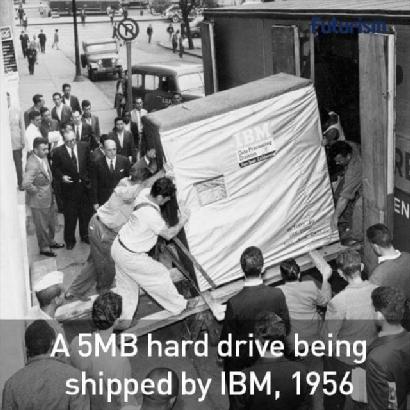
Measures of Success: from 1956 Newtonian measures to 2020 measures of non-hierarchical software potentials
Business education has centered on managing the idea of “the media as the message” but it choose the wrong measures of success. In addition, even if it would have centered on the softer measures of IT, it would have missed the eventual importance of content. Most business operations were sucked into superficial understanding of IT as media fixated but still content free, except of course for “large data” where even large mistakes are underway. The question for half a century has been: “what the hell was and is the message”? The presumption is that technology will become more important to human affairs but only as artificial intelligence to replace lack of intelligence. It is time to move to intent and content, not marketing of form to customers without care.
IBM of the fifties provides an interesting metaphor of the problem and mis-direction. As the form of what was thought to be the challenge becomes increasingly vacuous and ephemeral it is time to finally confront issues of content. Content to date has been between denigrating, evil and silly. Business education via more IT and less hierarchy faces tough challenges. Much in management education is based on how do to the wrong things with ever more efficiency until automation allows wrongfulness to be done with perfection. Innovative alternations to the growth of demoralizing and unethical ideas of OB and HR people treating humans as resources with behavior to control via leadership without direction.
The following diagram gets to the essential aspects of what OB and HR professors offer students in their business school courses. There is an argument for dropping all such courses prior to moving towards hope for improved business in the 21st Century.
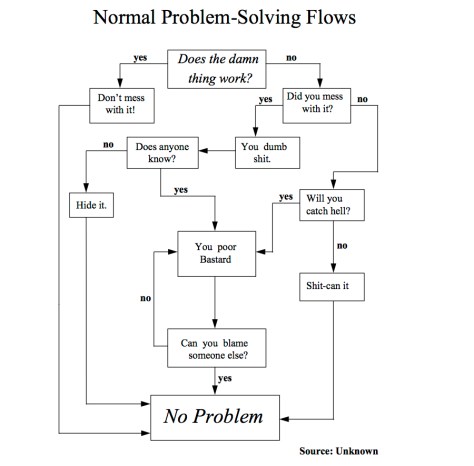
The Human Resource Approach to Problem Solving, Surely HR Professor can do Better?
Accepting the dictates of the OB (Organized Bullshit) types management becomes a game of problem avoidance, not solving or redesign for human understanding and improvement. The above diagram I developed for use in management classes to allow students to understand from where their life’s work would come under the management of OB and HRM thinking. “No Problem” as the key to success.
In fact, the HR OB regime is much worse than I suggest. If you can stand to go deeper and darker please look at the March, 2018 issue of Fortune on “Why HR is not your Friend”. It is pretty bleak. If a business school offers courses in it, don’t go there. If a business has that department, don’t apply there. The alternative means to deal with HR OB issues more objectively is found in new forms of management AI. There is much less bullshit in such. Lacking any content HR OB instructors dwell on power issues and how to capitalize on gathering power. Sad.
2. A NEED FOR A 21st CENTURY BUSINESS EDUCATION, SEEKING BUSINESS AS UNUSUAL
Business school classes presume we know what a good education is and how business works best. We in fact know what we know in each is problematic.


Contemporary education is structured via 19th Century ideology and its hierarchical limitations. The business processes being idealized in the business cases that form the content of business programs arise from 20th Century men speaking from their blind faith in 19th Century ideas about industrialization as the means of society. The consequences of the results thus achieved are ominous and now growing. Educational variety and improved business ideals are available, and needed.
Change and how we respond to it is a crucial element of business management education and practice. Image A above illustrates the need to change while Image B illustrates a normal maladaptive response to the need.
Beyond debates about can change be taught in organized rows lectured by those with no business experience on a raised platform, there are questions of what business acumen is. Even today there remain professors lecturing from Newtonian principles of force-counterforce physics as a metaphor for organizational behavior, or Maslow’s “hierarchy of needs” as a way to keep worker expectations and rewards lower then needed. Few of those who profess, are even aware of early 20th Century knowledge that there are no straight lines in nature nor of Einstein’s overriding principles of the path of least resistance is in fact the shortest distance between two points. Strategy teaching continues to assume as its founder Clauswitz did, “strategy is deceit,” and must be so deemed and applied to win. MBA accounting classes assume a zero sum game where things can only add up if what one gets others must lose. Ideas of mutual creation of wealth to be mutually shared are too complex for the classroom and its final exams. Selling what is not well made nor even needed for human well-being becomes the standard of marketing excellence. And finally, human resource management presumes humans are resources for others, not individuals, and certainly not possessing free will. Organizational behavior professors illustrate the low point of what is counter productive to 21st Century business needs. ,They illustrate how lacking any sense of distinctive competence in life can be an asset to professing. Complete elimination of an HR department in a business organization illustrates their role in keeping improvements and beneficial change from that organization. (I recently did this for a Chinese firm of 150,000 employees.)
There has been much debate as to whether 19th or 20th Century principles are the most appropriate, or are both largely in the way of 21st Century needs. much like noise. All principles deal with metaphorical examples in order to provide quick insight to finding out what you didn’t know. Just now the debate in business is shifting from traditional hierarchies to network form organizations based on connections, not status and levels of operation. The challenges from the 21st Century are well beyond the capabilities of size and hierarchy. The role of the individual is replacing the department of human resources. Steven Jobs was an early indication of this shift. In responding to conditions of turbulence is it best to avoid time honoured principles that impede adaptation, just as culture serves to keep women in a reduced role in society.
What is the role of a “school” in that process? Is the school a facility or a computer screen? What subjects can be best learned in a classroom, which can be acquired easier on internet and what knowledge is best acquired via actual experiencing of it? Is a business education best learned via a combination of the two? Some of the most noteworthy leaders in business dropped out of business education. Does this mean leaders should avoid school and only followers need schooling in business practices? These are related questions are examined herein.

Copyright (c) 2007 Kai Chan. All rights reserved. http://400d.com
3. NJIT: LOW ASPIRATION FROM LOW BEGINNINGS
Founded as a labor trade school, NJIT grew into as an engineering college, and then raised its aspirations from a school to an institute. This title change was done by adding a second school, a School of Architecture. Other schools were since added, including a “management” school in 1989 despite the protests of the Rutger’s Business School across the street and exacting NJIT’s promise to never become a business related school, on “management”. When Governor Christine Todd Whitman abolished university oversight there was no one to oversee the prior promises. NJIT could do as it pleased, even if not done very well. The state went from public colleges being monitored by the state to an open Darwinian struggle of survival of the fattest. Adding a business school is a bit like returning to the trade school tradition in that the MBA is not seen as theoretical or scientific based. They are mostly a university profit center where funds are raised from local business via them. A growing joke is how the MBA stands for Mentally Below Average. This was first used at NJIT while we were on a trip to Hong Kong Disney to listen to Disney’s Micheal Eisenor opening of the park. He greeted NJIT’s MBA students by asking if they were part of the Mentally Below Average that are coming into business?
It could be about any university program during the last few decades. A university degree is seen as a key to life success, yet it moves from understanding the universe model to a model of narrow training. There is little concern for questions of meaning of life and the integrated whole. University leadership and teaching has mostly failed students, society and humanity. The discontinuities between subjects have generated many social and more recently mental disorders. This is a continuation of the German model of the 1930s where a move was made in universities away from learning of the “universe” of things and instead emphasizing “professional” training. Students would become “educated” in something akin to the high school tradition, and often a trade school model. This is where increasingly narrow fields of inquiry would be favored, not unlike STEM programs. . This would keep students from former concern for the meaning of life and questioning of the purpose behind those assuming leadership roles. Ivan Illich offers much on this shift and why the new university model was important to building a more obedient and non questioning society. Ethics and morality would no longer be discussed but assumed to be whatever leadership did. This was the the advent of what I will later describe as the shift from leadership to Leadershit. Consequences of this shift are at the heart of current society concern towards the current role of lawyers in governance and the politics of status quo where emphasis if given to the role of law over the role of truth or morality.
Thus, the basis of a business school in this environment is probably questionable may even be counter productive to an improved society in a changing context. This site is about the emergence of a business school and its evolution towards higher or lower forms of life over a twenty five year period. The role of the law, lawyers and justice in setting the frame for that evolution will also be presented to highlight impediments to institutional improvement.
4. NJITBS, TRYING TO BECOME ONE MORE 19th CENTURY BUSINESS PROGRAM
A new business school was opened at the New Jersey Institute of Technology in 1989. There already was a state supported business school across the street at Rutgers University. As such the State oversight authority, the Department of Higher Education, saw no reason for another public business school. To gain approval NJIT agreed to restrict their program to education in industrial management, whatever that might have been? This was acceptable to Rutgers in that no one knew what industrial management was, as the industrial age was ostensibly dead. After the Board of higher ed was disbanded in 1994 the NJIT program forgot its promises and become similar to the Rutgers program. This was important to the development of the NJIT program in that over time it became obvious that an education in management was not synonymous to business. During job interviews graduate were asked: “Your degree is in management, management of what?”
In 1998 the school added a MBA degree and shifted attention away from its prior MS. In become more like most school of business it became less interesting and say hundreds of MS students quit or transfer. The going mainstream when mainstream was in dispute seems to have been a mistake. The School could have kept its special concentration on MS degrees while organizing them within a School of Business. Students and companies preferred the flexibility of the 21st Century MS degrees, not the lock step two year MBA program designed for 20th Century firms. Leading Schools of Business are now beginning to develop new MS degrees. NJIT was ahead of its time and seemed to not know it, and thus moved safety behind the times where it now sits. The MBA is mostly for people with no knowledge of business who will acquire the precepts of business as usual, business that often fails these days. The MS is for those with some experience in business, and of greater importance ideas of what business needs to become. They then seek concentrations that can become a business, say information technology, international business or entrepreneurship. Knowledge of general business is now beside the point as most people have some experience in business, even as customers relative to what is missing
Finally, in 2006 the Management School began to title its undergraduate degree, BS, as a BS in Business. It was to have also had an MS in Business but President Altenkirch’s 2008 Interim Dean English eliminated it saying he he did not understand it. At least in so saying he was being honest as he had no education or experience in business, or perhaps thoughts about what business might be like if it was improved.
This “dean,” a Mr. Bob English with very limited academic credentials, was selected by President Bob Altenkirk to become a “five year” interim dean in 2008 to repair the extensive wrong done by Dr. David Hawk in his two and a half years as dean. President Altenkirch, who also had no knowledge of or care for business, had a feeling that Hawk must have done much wrong, although he could not articulate what wrong was done. Hawk had a PhD from the world’s leading business school, helped many students start their own firms and had decades of experience in advising firms. Relative to the schools’ development why then was Hawk replaced with an amateur in business education? Perhaps that is an important question to understanding the history of NJIT’s business program or the mental state of the former NJIT President, allowed to act as he wished with no NJ State Oversight. Later on it became apparent that the paranoid and ill-informed had replaced those concerned with education. In 2012 the interim provost of the time had testified “There was a feeling that Hawk was going to return and take over the University and to protect itself Hawk had to be banned from campus.” Altenkirch and English were both from Purdue engineering, with no knowledge, interest in or connection to business education or practice. One san only wondered why such people and leadership ruled the day?
Graduates sometimes reference NJIT as a “Not Just In Time” education, but that can be said about all business schools. The only consistently relevant outcome are the relationships make in the School, good and bad with a hoped for emphasis on the good. In addition, how a school is perceived by other business schools can be a measured outcome. The most noted measure of this is in the annual evaluation by US News and World Report. They evaluate all 464 business schools in the AACSB system. In 2015 NJIT gained no business school ranking from the AACSB deans. This does not mean NJIT was bad in 2015, only that no one noticed it for comment. In 2008 there had been a special celebration staged at the AACSB annual meeting to present NJIT as the most improved business school in the AACSB System. Sadly, its dean during the years that resulted in this evaluation, David Hawk, was not allowed to attend the meeting by the then President Altenkirch as he heard Dr. Hawk was going to take over the university, per testimony in a 2012 legal hearing in New Jersey. During 2008 NJIT also entered the Princeton Review’s ratings where the business school was ranked as one of the top ten in the New York Region. This seeming steep drop in its noteworthiness of the school means little except that its graduates are less thought of, not badly thought of, nor ill-prepared to work in business. The rankings are done by all deans in the 464 business schools. Now, in its Newark Region location NJIT is seen as a not particularly good school, with few outstanding faculty, due to it having gone from being highly selective to accepting almost all who apply, but none-the-less it continues to attract many very good students.
5. A BASIS FOR A NEW BUSINESS SCHOOL, A new Syllabus and Course
Mgmt 699 – Business Ontology: Limits to Knowledge, and How Business Must Learn to Overcome Them (i.e., how to speak less like a business idiot)
Introduction, the Reason for the Course:
Education in American business administration, acquired via an MBA standard, worked well for several decades. It supported and accompanied the US in becoming a world business leader. Relying on what was known, with what was needed, via case studies and other ritualized methods provided a recipe for success. The more reflective, with time to pause, never quite understood why success was theirs, but it was. That is now changing. The recipe and inventory of success is being washed away via extraordinary 21st Century challenges.
No longer the dominant, or even the consistently best model of enterprise development, the US needs to return to the innovation pool. Some argue that the innovation pool is no longer in California while others argue that it is no longer. Still others argue that innovation exists but can only be seen while on your knees in desperation.
Regardless, in our emerging challenges we see incredible opportunities to reshape the definitions of success and reinvent businesses that support improved human well-being. Only business as usual offers pessimism.
Today’s challenges are unlike any we are prepared for. Business models need radical adaptation to fit current and emerging conditions. Under conditions that are unstable and discontinuously we cannot rely on father’s values, or perhaps even mothers. Emerging instabilities associated with the emerging realities are likely to grow. Current levels of ambiguity followed by instability might well be attributed to our earlier and badly informed responses to business conditions thought to have been stable. We are clearly the problem, even when it seems to come from out there, it is easy to see we sent it out there to come back and trouble us.
This notion, “that we have met the enemy and they are us,” is controversial. Most of my more egocentric colleagues go for cover when I make it. Previously I passed out a book chapter to illustrate the thesis. This was the 80s article on why the myths that guide America are due for a rework.
In 1980 there was a widespread debate about the availability of oil. The predominant side of the argument was that there would always be oil but that the major oil companies were manipulating its price. I argued that there oil would always exist, but the last barrel would not be affordable by the general populace nor would they afford clean water. Exxon could, and would, manipulate price in the short term, but such discourse was a smoke screen for more important concerns. As such, embracing higher oil prices in the eighties would help transition out of oil while we still had ample supplies. If energy would fall we would only confront greater problems from its expanded use. In 1981 a “new American leader” rode into the scene to communicate about “American optimism” and to restore an 18th Century industrial model. His advisors argued that, with a loan (an Adam Smith idea), we could throw a big party and jump start the economy. We were instructed to simply forget issues of energy and environment, and the pessimism they implied. One of his most noteworthy comments went something like: “Computer chips or potato chips? Who cares which we make, as long as we can make one of them.” Real American’s liked what they heard. Let the good times role. Party time. Wow.
Business development did rather well during this stage, at least until about 1986 when two difficulties became apparent: a) business expansion had relied on a $5 trillion loan from our allies, and b) made extensive use of an enterprise model where expansion would be based on imports, and servicing them, and not concerned about goods exports and economic balance. The next five years were pretty tough.
From 2001 until 2007 we threw another version of the same party. Now, twenty-eight years after the first attempt to feel good by redoubling our efforts after loosing sight of our direction, we have a hangover from “party time.” Our current and growing $9 trillion loan obligation, plus interest payments added to international skepticism about our values, models of financial management and general conduct of business is troublesome. They who argue we remain the envy of the world must not have a passport. Adding this to the steadily growing difficulties in selling US designed and produced goods and services to an unappreciative world, even with a greatly reduced currency value, poses even greater troubles. Services, where we are reportedly quite strong, are being perceived as more marketing than service. Even if the above is a significant exaggeration, and I hope it is so, we have some great challenges. The American tradition of business, the one we have come to know and revere, and that we inculcate via our teachings in schools and churches, is clearly endangered. New models are needed.
6. A PLACE FOR BUSINESS ONTOLOGY, Center for Corporate Rehabilitation
In 2003 a small conference facility was construction at the center of a 1,500 acre family farm in Iowa. The farm is experimenting with new ways to life with and amongst nature. The Facility is consistent with this, and provides a location for business leaders to address new ways to do the better, not improvements to the efficiency of doing wrong things.


Setting for Center for Corporate Rehabilitation


Interior Spaces within the Center


More Interior Spaces
7. MORE BUSINESS ONTOLOGY
A. IMPROVING KNOWLEDGE: HOW TO LEARN WHAT YOU DON’T KNOW
Business innovation will arise from new knowledge and methods for preparing today’s business students to be leaders in responding to tomorrow’s surprises. Chances are that these will result from two sources: heretics to the US business system or thinkers in the business systems of other countries. Behind this course is a hope that change can arise from people like you, although early feedback from one of the prior version of this course point out that this might not work. Let’s see how it goes the third and last time this course will be given. Perhaps we need some rude experience from our economic systems to see the light. Or, perhaps, we need to perceive that it’s too late before we respond to demonstrate that it’s not. Regardless, what is the intent of the MBA and how do you rationalize its content?
Graduates of an MBA program were never intended to be experts in sociology, math, science, philosophy, languages and economics but only to acquire sufficient doses of each so that they might understand enough to be able to weave together a viable business fabric that could be relevant to each situation. An MBA graduate from a good school could traditionally do this in a way that reassured. In some instances their skill sets and abilities were pretty impressive. Contemporary business leaders that hire MBA are no longer very impressed. Their criticism is that graduates lack skills in dealing with surprise, ambiguity, complexity and contradictions, and the salary level they ask for seems more impressive then their problem management skills. I think this second issue is called arrogance and it may actually be behind the first issue. The Feb 4th, 2008 issue of Business Week reports that CEOs believe part of the blame for this rests with an extensive reliance on the Harvard case method. I have held this same point of since I started teaching in SOM in 1991, even though repeated attempts have been made to get me to see the value of cases. At other schools where I teach management I have never used a case, nor been asked to.
The premise of this course is that while some of the blame can clearly be placed with case method pedagogy and the intellectual laziness it encourages in teachers and students (a bit like distance learning as it’s mainly offered) the problem extends well beyond case method. Realizing this is heresy of the worse form, I think there has been too much reverence given to the empirical over the rational. During the course we will try to understand why and how this has happened and why it disables business graduates that must operate in unstable environments. Relying on experience for learning is nice, and fun, but is perhaps the most inefficient means to learning known to the species. If we were immortal the extensive reliance on experience would make some sense. Since most of us are mortal we need to be a little more expansive and creative in our ways of learning. People say the MBA stands for Mentally Below Average for several reasons; perhaps this is the main one. We need to get over our adoration of experience, yet not return to irrelevant rationalism. This course is an attempt, perhaps the only one in the US context, to find a better relationship between the strengths of reason tied to experience, not one have distain for the weaknesses of the other.
As suggestion before, MBA graduates were placed on pedestals in the late 1950s.but by the mid-1970s serious cracks developed in their responses to serious challenges. Surprise and uncertainty associated with such items as energy limits, environmental dislocations and consumer anger surfaced. Management responded quite badly. Detroit built larger autos, GM built larger top loading washing machines, and the military tried to market its winning of a losing war. All of these mistakes were helped via operations models designed by the “best and brightest” management thinkers. Finally, the challenges were put on a lay away plan and labeled as “contingencies.” We would pick them up later when our OR methods had been “upgraded” to accommodate more varied multivariate analysis that could clarify the causal relations. The leader of OR model development left the field at this time in some disgust. He moved his educational program, at the Wharton School, on to preparation for mess management. While his school soon became ranked as the best management school, the reasons went largely unnoticed by general management education. When mainstream schools finally softened their dependency on OR they move into teaching strategic thinking, which would eventually become an even larger problem for business schools and their graduates.
In 2000 the situation of management was dire. Some of the leading educational programs responded with attempts at innovation, but mainstream programs simply lowered their heads, and their admissions requirements, and waited for the return of their “customers.” Customers did return in 2005, but now armed with higher expectations and lower tolerance for the irrelevant. Business school deans were asking what is happening here? Just as we find a way to respond to one set of impossible challenges an even more impossible set pops up. I have argued that it might be that our responses to solving the earlier difficulties ends up creating even greater future difficulties, etc. This is obviously not a popular stand to take. I was recently kicked out of an Oxford book writing project on the future of management for writing a chapter on my thesis.
Clearly, the traditional MBA training abhors surprise. Its coursework is organized to avoid, or ignore, difficult contextual issues and “outliers.” To me, this pathway teaches arrogance and assures ignorance. This may be the larger problem looming for US business. At some point the A in the MBA needs to be replaced. Perhaps it can be with something more relevant and accommodating of our dynamic and discontinuous realities. Alternatives might be: Innovation, Design, Intelligence, Survival, Sustainability, Relations, Excitement, Sex or simply Fun. (These last two are for those that liked the first two parties that our economy threw and sort of feel good about what they learned about the parties held during the decline of Rome.)
B. EMERGENCE OF THE INTERNATIONAL
Gaps have clearly appeared in the fabric of business; especially at the international dimension. Those who do not yet see or feel this might look at the virtual desperation underway in leading MBA programs to find alternatives to training their students in functional areas, while urgently trying to pretend an international set of courses that go beyond training missionaries. As such, these schools these programs work to at least graded their focus from memorizing structures to confronting the role of improved judgment skills. While a credible international business program has yet to be designed within a US business school, there are encouraging signs that some deans of leading schools see a need for one. With significant changes in the human fabric, and its conditions of survival, less insulation is now found between cultures, growing economic, national and religious intolerance and an emerging awareness of resource limits. The foundation of business methods, models, myths and ideals are being challenges and changed.
Business operations, that needed to navigate through troubled waters face a growing array of difficulties associated with changing attitudes, desires, limits on resources, rapid emergence of unforeseen technologies and infrastructures that divide as well as connect. We need to rise above our simplistic, feel-good thinking. For example we might learn to presume that by “convergence” we should mean “divergence.” When we hear about a “failure to communicate,” mostly from relatively low IQ HR people, we are better served to presume that there was perfect communication and that there were real reasons for why individuals pretended to not understand; e.g., because what was being said was another episode in strategic lying. Negotiating with the truth can sometimes be a refreshing exercise for an organization. The results might turn out a bit like an enema but the longer term consequences offer hope.
Perhaps the best means to manage complexity is with truth, but then again there appear serious threats to the traditions of management. Just as the models of control that were replaced by models of management, and are now as insufficient to the needs of their time as methods of control became during feudal times, we need to upgrade the stakes. What do we mean by upgrade? Where will we look to find the myths, metaphors, models and measures that are more robust to our time? How do we locate and idea that motivates us to rise above the limits of current business knowledge? How do we see that this is even necessary for our survival as a species? Why would we even care?
Another way to see this is to look into the economic theory that you should no from your studies in school and experiences as a citizen. Their was a metaphysical acceptance of the importance of the economic argument between Karl Marx and Adam Smith. Most did not notice that the argument was becoming vacuous by the 1990s, and by the 21st Century it is simply a curiosity. While is still a viable basis to go to war, it in face is mostly a solutions in search of a problem that cares. Alternative economic ideas, arguments, agendas and requirements have been surfacing for some time in most parts of the world. The world was no longer centered on American business. Part of the esteem for the US way of business, and living, was endangered by arguing for others to protect human rights while we accepted torture upon those who would threaten our defense of human rights. It’s a bit like the spouse who is 100% faithful, except for once or twice. Quite simply we need to see how many traditionally disconnected topics are finding a way to in reality to be connected. Then, we need to be a little less constipated about our responses to the resultant complexities. The platform for soco-economic ideas and ideals, the raw material of business, has been transformed. The role of the business enterprise now needs to be changed. Based on this, we can pretty clearly see how the need for a standardized, accredited MBA curricula is now seriously not needed. New business truths, values, ideas, ideals and motivations are needed. From where will they come?
C. THE SPECTRE OF INNOVATION AS THE ENEMY OR ALLY
Innovation in organizational design has this year become as critical to success as product design and innovation were last year. To manage this complexity we need to see what is similar and what is different amongst these changes. This needs discourse. To begin the discourse we need to accept that structure and form will only get in the way, just as hierarchy has long stood in the way of improvement. In simpler terms this means that we need to get over the weak democratic argue that if people can vote the results will be ok. Instead to allowing people (employees) to vote on alternatives we need to allow people (employees) to design the alternatives on which voting can take place, although when this is use voting is mostly beside the point. During the discourse phase the most exciting alternative becomes rather obvious. The contents of this course are an attempt to open up the above subjects, and do so in a way that allows helpful glimpses of emerging conditions as well as insights into how best to embrace them.
While only the smell of long dead fantasies about control linger, the principles of management are now mostly dead. I use the term negotiation as the alternative approach to building and developing an enterprise. If you have a better term please propose it. The important issue is that this alternative to management will change everything we do in an MBA program. For example, the refuge for those who studied organizational behavior in their PhDs, and were embarrassed about it, has been flight to subjects like institutional finance, R&D management and management of technology. As this idea never became useful for a company, which is a pretty good measure of an idea, we might instead consider the challenges of the “technology of management” instead of the “management of technology.” Technology of management, conceived by executives I work with, is consistent with replacement of the traditional manager. While it might seem to threaten you job it in fact can make you more valuable and knowledgeable. I would hope that such issues can be raised and explored in the course discussions and in your projects for this course. The MoT issue is a bit trivial, but it is the label you will have placed on your diploma and thus you might want to know how to questions you will receive about its meaning.
D. THE COURSE: EMERGENCE OF THE ONTOLOGICAL ENTERPRISE
We may end up confronting the management dilemma as we address the “Planners Dilemma,” the “Prisoner’s Dilemma,” and “Heisenberg’s Uncertainty Principle.” The planners dilemma illustrates why syllabi were a good idea in the 19th Century, somewhat limited in the 20th Century and now an obstacle in the 21st Century. I’m aware that some of you complain about not having a syllabi, like having a security blanket against any surprises and unfairness, but you shouldn’t invest much in that argument. The “planners dilemma” illustrates why you don’t need one, but probably shouldn’t have one. I offer this one to appease those with too little insight and too much pride.
The “ontology” term, as used herein points to a set of issues that business people do not normally want to confront. When they arise executives turn to consultants, who dutifully report back that all is well and it is best to avoid issues that give headaches. As such, the language for addressing them is uncommon to an MBA course, and very limited. None-the-less, ontology and its supporting concepts provides one way to access the critical importance our growing need to better understand the limits of knowing, and how best to negotiate with them. Tomorrow’s leaders will be those who improve their ability to see and deal with the limits to knowing, and to find better means for dealing with such limits. This will of course involve innovation, but more important is that it involves a shift from the sanctity of the core and towards improving the capabilities in working at the edge. In many respects we are at the edge of sociological and technological systems development. We can see early signs of this in our confronting the edges of ignorance in much of what we try to do. On a more serious note, it’s most obvious in how we conceptualize the relations between business and systems of living order; often called natural systems. We need to do better. Hopefully some of you will ask what better means?
Specialized means for researching and developing in companies (the R&D functions) are no longer serving organizations. They fail to tap the full extent of innovative potentials in the surprising resources found in each individual and social group. The entire enterprise of R&D needs to be rethought, and perhaps renamed. This course is to prepare you for such rethinking.
E. STAGE ONE: TO LEARN OF RESEARCH, i.e., to search again, in order to see for the first time
Management researchers generally are not researchers. They have no labs and seldom visit those they talk about. They mostly seek their truth under the street lamps as they claim the light is better there, even though what they seek is well away from the lamp. What they call research others call writing up the results of research. Mostly they rely on third generation data organized around second rate mathematics. Business research needs to do better than this.
Business research should no longer be conceived as a secretive and separate function hidden away in the woods. It must involve those being discussed, must be in the open and become open, interactive and interdependent. In this way we can better see the extreme limits of what we think about and how we think. The understanding of business ontology does not arrive in the dark of a closest. With an open systems approach we can then begin, for the first time, to see what business is. As many members of an organization as possible need to be involved, even those who silently watch others happily make foolish mistakes. Let us begin the process. All are welcome, and needed.
F. ACQUIRING THE CONCEPTUAL, the conceptual tools to find the edges of knowledge, and survive while out there
-
Constructs/Concepts
-
Both plus more
-
Unaided rationality
-
Logic
-
Problem types
-
Planners Dilemma
-
Principles of Management
-
Environmental Types
-
Change/Changlessness
-
Etc.
Assignment one: In five pages to less, describe something you know with certainty, and something you certainly don’t know. This will help you access the sense of what ontology is, and isn’t.
G. BOOKS FOR THE COURSE, AND YOU
Course Books for Management 699
Prior to opening the book, or reading the papers as copied you should read the “History of Knowledge” document as attached. Its author, Piero Scaruffi, found at www.scaruffi.com, is also the author of the 2003 “Thinking about Thought.” The approximately sixty pages provide a good introduction to the scientific breakthroughs of human thinking endeavours cast against a socio-economic-political background of events that defines business success, or failure.
In addition to the extensive copies of articles you were given at the outset of the course you will be given the following books a week to two after the course meetings begin. You might want to read the books in the following order, but if your intuition suggests another order for reading then please go ahead and follow you instincts, since that was/is an important part of the course. To be overly rational is to be intrinsically disabled.
1. Hamel, Gary and Breen, Bill, The Future of Management,
Harvard Business School Press, 2007, $25.
I, and those I work closely with, have never found Gary’s books especially enlightening. This one seems consistent with that quality. None-the-less, it’s important for you to see what a Harvard kind of person says about changing management ideas, to get a sense of how mediocre you can be while marketing yourself as advanced. Unfortunately, those who buy into this kind of business book don’t have much time for reading or reflecting on reality. The book’s contents will probably seem interesting for a year or two, as long as you don’t probe too deep. It’s included as a “bench-mark” guide of how to market being mainstream as being at the edge. It’s a pretty easy read, and for some readers is gives an idea of why this course is being offered to MBA students who desire to lead tomorrow after putting up with pretty bad leaders today.
2. Williamson, Timothy: Knowledge and Its Limits, Oxford University Press. $29
Williamson is an Oxford Professor of Logic. The book is generally well done, and takes you closer to the cutting edge but it’s a cutting edge of mainstream thinking, not the edge of the edge, i.e., not what I’d call an exciting map for the future. It avoids most of the non-rational issues that face those dealing with knowledge and knowing in the future. It also avoids many of the ancient and yet unresolved issues of human thinking and thoughts, especially those that arise in the east. On the brighter side, if your colleagues at work see you reading this it will raise your chances of getting them to listen to what you say. It’s essentially how to improve what we are now doing, not how to find new/better things to do. The contents can be helpful to current issues and methods of business, such as IT directions and technology directed research, but it’s not supportive of revolutionary thinking. Again, it’s not the center piece of this course, but more contextual.
3. Merton, Robert and Barber, Elinor, The Travels and Adventures of Serendipity, Princeton University Press, 2004, $29.95.
Things now get better, more interesting and more controversial. More to the point, this is where challenges will begin. Merton is one of the great social scientists of all time, and since management science is viewed as second rate SS it is a good idea of raise you head and see what the deeper thinkers think about social systems. This will get you closer to those that are concerned about the future of the human condition, and a bit further away from those that write simple-minded management articles with bad statistics of third generation non-data.
The contents of this book provide a good platform for those who have tried to use strategy formulation, rule-based management, operations research and operations management and found it less than interesting and not helpful in responding to change and complexity. If you’d like to confront the underlying dilemmas and necessity of corporate planning, as presented in this course, then this is a very helpful guide to the roles of “luck” and “chance” in all that corporate planners attempt to do. It provides some rather good suggestions as to where to search for the edges of knowledge in social systems. Consider that this book was written in 1952, intended to be published upon the death of the author, and when he died not a word was to be changed. None were.
4. Holland, John, Emergence: From Chaos to Order, Addison-Wesley Books, 1998.
Now things get closer to falling off the edge of the future. Ideas found herein are critical to those developing the leading science and technology in a number of arenas. Most of the world’s best researchers think very highly of the workings of people associated with this person and the Santa Fe Institute of which he is an important member. John is a prime example of what you might think about when you are at the edge of knowing. He is a Fellow of the World Economic Forum and widely known as the “father of genetic algorithms.” Many companies have used his work to critic and guide their R&D direction including some I’ve sent to him. Management science, as taught most places, can go here.
5. Feyerabend, Paul, Killing Time: The Autobiography of Paul Feyerabend, University of Chicago Press, 1993
Feyerabend was a professor of philosophy, University of California, Berkeley. He was a very gifted and troublesome individual. He died in 1994, but prior to that I found him amazingly helpful to criticizing everything. He critiqued some of my most closely held beliefs. Except for Nicholas Georgescu-Roegen, Feyerabend was perhaps the most helpful person I ever met. He was very helpful to a 1989 project via highly insightful criticism of the then leading methods of research, including international business research. Via his work we formed and carried out the Conditions of Success project. This is one of the research efforts we will discuss in class and one that has recently become a key illustration for the new kinds of research to be done by the World Economic Forum researchers. Be careful if this book excites you. You will most probably not be quickly promoted or placed in fast track leadership training. On the other hand, you might wake up as a CEO without the track, based on understanding the turmoil created by the decisions of the fast trackers. This thinker is closer to the eastern approach to understanding, and illuminates some of the mistakes we make in the west.
“In the west we state that science is where you can ask the same question twice and arrive at the same answer. In the east they ask why would you ask the same question twice?” (DH’s prior writings)
6. Fugere, Brian, et. al. Why business people speak like idiots, New York: Free Press, 2005. $22.00
In case you are confused by the ideas and words in the above books and want to “know the point of all this,” then you should find this final book helpful to you concerns. Over the years I’ve found that undergraduate students and CEOs tend to have little difficulty with the language and concepts I rely on. Graduate students and middle managers often do have trouble with my critic of management systems, and prefer books like this that point to the problem but don’t confuse things by addressing a resolution. Enjoy.
H. CONCLUSION:
On a slightly more serious note several companies I work with operate in ways that are compatible with the mission underlying this course and the EMBA program as it was designed up until February. Now it seems to have returned to faculty appeasement and 1970s focus group discourse.
Most firms that are fairly advanced in the thinking we use in this course are not American based, although they operate in the US. Recently more American Head-quartered firms are emerging in this interesting group. One I work with has been in the news in the past week as follows:
A GREAT COMPANY ABOUT TO ONTOLOGICALLY NOT EXIST, Medco, March 6, 2008
About Medco
Medco Health Solutions, Inc., (NYSE:MHS) is the nation’s leading pharmacy benefit manager based on its 2007 total net revenues of more than $44 billion. Medco’s prescription drug benefit programs, covering one in five Americans, are designed to drive down the cost of pharmacy health care for private and public employers, health plans, labor unions and government agencies of all sizes, and for individuals served by the Medicare Part D Prescription Drug Program. Medco, the world’s most advanced pharmacy™, is positioned to serve the unique needs of patients with chronic and complex conditions through its Medco Therapeutic Resource Centers®; its diabetes pharmacy care practice, Liberty Medical; and its specialty pharmacy operation, Accredo Health Group, Inc. Medco is the highest-ranked independent pharmacy benefit manager on the 2007 Fortune 500 list. On the Net: http://www.medco.com.
Medco Tops Fortune’s List of ‘America’s Most Admired’ Companies in its Industry. As friend and advisor to Medco’s CEO, I marvelled at how well run this ontological project was managed. Recently they needed to go the next step to develop business beyond their limits. I recommended they go international to meet their limits, e.g., to China. I had an expansion program worked out for them via Tsinghua University and the City of Guangzhou Medical University that was experimenting with an integration of Eastern and Western Medicine in the 21st Century.
The Board just rejected that ontological idea. It was seen as too far beyond the edge of reality as they knew it. So be in. I hope they survive.
Medco listed No. 1 Among Health Care: Pharmacy and Other Services; No. 1 in People Management;
Runner-up to Berkshire-Hathaway as Long-Term Investment; No. 3 for Innovation
MEDCO: FRANKLIN LAKES, N.J., March 6, 2008 – Medco Health Solutions, Inc. (NYSE: MHS), captured the No. 1 position within the Health Care: Pharmacy and Other Services sector on Fortune’s America’s Most Admired Companies List. In addition, of all companies surveyed, Medco was ranked No. 1 in People Management. Medco was listed as No. 2 among all companies as “Most Admired: Long-Term Investment” – second only to Berkshire Hathaway; and third in the U.S. based on “Innovation,” trailing Apple and Nike.
“To be ranked highest among our industry peers is a tremendous honor. To join some of the world’s most revered companies across all industries – second only to the legendary Berkshire Hathaway as a quality investment and in the same league as Apple and Nike for innovation – underscores the value Medco delivers to the marketplace in improving clinical and financial outcomes for the millions of Americans we serve every day,” said David B. Snow Jr., Medco Chairman and CEO.
Fortune, in partnership with the Hay Group, surveyed 622 companies across 64 industry sectors. To create the industry lists, executives, directors and analysts were asked to rate companies in their own industry on eight criteria, from investment value to social responsibility. Results are featured in the March 17th issue of Fortune magazine.
According to the Fortune survey, Medco received several industry and national honors:
No. 1 Most-Admired: “Health Care: Pharmacy and Other Services” category – with the industry’s highest rank in each of eight attributes: innovation, people management, use of corporate assets, social responsibility, quality of management, financial soundness, long-term investment and quality of products/services.
No. 1 nationwide in People Management
No. 2 nationwide for Long-Term Investment, following Berkshire-Hathaway.
No. 3 nationwide in Innovation, following Apple and Nike.
No. 3 nationwide for Quality of Products and Services, following Anheuser-Busch and
Nordstrom.
Fortune Most Admired, Page 2
No. 6 nationwide for Financial Soundness.
No. 7 nationwide in Social Responsibility.
No. 10 nationwide for Use of Corporate assets.
Among the most admired in New Jersey.
Continued Snow: “Innovation and quality describe not only our company, but the values of our people who are dedicated to pushing the frontier of pharmacy to improve clinical and financial outcomes – ensuring quality care remains affordable and accessible.”
Medco is redefining pharmacy practice by employing hundreds of trained specialist pharmacists to help improve the quality of care for patients with chronic and complex conditions. These pharmacists are better positioned to identify safety issues and consult more effectively with doctors to improve patient care and help lower overall health care costs. The specialist pharmacists work within the Medco Therapeutic Resource Centers®, with specific centers located nationwide focused on conditions that include diabetes, oncology, arthritis, high blood pressure, high cholesterol and neurology/psychology.
J. CONTEXT IS EVERYTHING, the context of a contemporary business education and its role in job placement
In case nothing else in this course and in your studies makes sense you might consider the follow bench mark to sort out where you should fit into the business workplace once you have graduated.
This addition is complementary of Marianne Kosits, Executive Consultant, IBM Global Technology. I had asked her for advise on how to best relate the education from an MBA course to what is needed in relating an IBM employee to IBM clients via new business school graduates:
MBA GRADUATES: FINDING THEIR ROLE
Put 400 bricks in a closed room, then put your new MBA hires in the room and close the door. Leave them alone and come back after 6 hours. Then analyse the situation:
- If they are counting the bricks, put them in the Accounting Dept.
- If they are recounting them, put them in Auditing.
- If they have messed up the whole room with the bricks, put them in Engineering.
- If they are arranging the bricks in some strange order, put them in Planning.
- If they are throwing the bricks at each other, put them in Operations.
- If they are sleeping, put them in Security.
- If they have broken the bricks into pieces, put them in Information Technology.
- If they are sitting idle, put them in Human Resources.
- If they say they have tried different combinations and they are looking for more, yet not a brick has been moved, put them in Sales.
- If they have already left for the day, put them in Management.
- If they are staring out of the window, put them in Strategic Planning.
- If they are talking to each other, and not a single brick has been moved, congratulate them and put them in Top Management.
- Finally, if they have surrounded themselves with bricks in such a way that they can neither be seen nor heard from, send them to Congress.
 NJITBS: Great potential but in need of innovation...not at the edge